Disruptive technology/ innovation helps create a new market and value network and eventually goes on to disrupt an existing market and value network (over a few years or decades), displacing conventional wisdom. In a dynamic market landscape, fan companies are poised to navigate disruptions driven by changing consumer preferences, technology advancements, and environmental considerations. Amidst this, our optimism towards Orient Electric lies in its resilient innovation culture, established brand equity, and proactive adaptation to industry shifts. With a track record of embracing emerging trends, Orient is well-positioned to capitalize on evolving market dynamics, ensuring its continued growth and relevance in the fan sector.
Orient Electric: A look at history
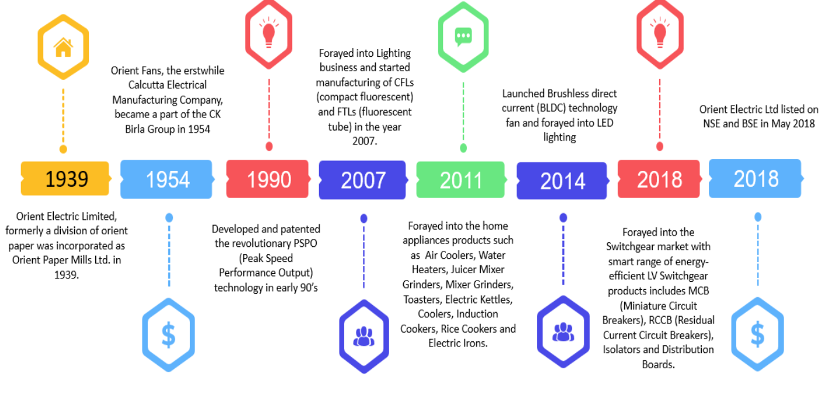
Orient Electric (OEL), was incorporated as a division of Orient Paper and Industries Limited (OPIL) when the erstwhile Calcutta Electrical Company became a part of the CK Birla Group in 1954. It was demerged from OPIL in November 2017, and listed as a separate entity. Over the years, Orient has been a strong name in the fans, lighting, and switchgear business for over 60 years and dominates the premium fans category with a market share of ~20%.
Exhibit 1: Major milestones of Orient Electric
Source: Company, Ambit Asset Management
For the longest time, Orient has been the industry benchmark in launching new SKUs across categories like fans, LED lighting, appliances, etc. Orient was amongst the first to commercialize the PSPO (Peak Speed Performance Output) range of ceiling fans. PSPO technology enables more air circulation across a larger area while consuming less electricity. Between 1994 and 2006-07, the company sold over 10mn PSPO fans, demonstrating the tremendous success of these fans.
However, despite this Orient did not command the brand premium that it deserved considering a lower investment in marketing and distribution. However, this changed once Rakesh Khanna came in 2015 to the helm of affairs. Orient focused on improving its product position by hiring better talent and focused on transforming itself into a brand that stood for smart, energy-efficient, and aesthetic appliances. Notably orient improved its capital allocation and generated one of the highest RoCE in the fans segment (32% RoCE – FY18-23).
Exhibit 2: Orient revenue share across categories (FY 23)

Source: Company, Ambit Asset Management
Business segments and SKUs
1. Fans:
Being the core category for Orient (62% of revenues), the company has pursued a strategic direction centered on establishing itself as a leading brand in energy-efficient and visually appealing products. As a result, it has successfully carved out a unique position in the market. Through a combination of launching premium product offerings and employing robust branding strategies, Orient has emerged as a market leader in the high-end fans segment with a market share of 20%.
From FY15-22, Orient worked on innovation and new product development and was the first to launch BLDC fans in 2018 and a new Cloud 3 pedestal fan with cloud chill technology.
Exhibit 3: Orient electric’s latest SKUs in Fans

Source: Company, Ambit Asset Management
Exhibit 4: Fan industry revenue market share estimates (%)

Source: Company, Ambit Asset Management
Exhibit 5: Fan industry market growth (Rs Bn FY 13-23)

Source: Company, Ambit Asset Management
2. Lighting:
OEL’s lighting business was introduced in 2008 (24% of revenues) to capitalize on the opportunities created by the transition of lighting products from conventional incandescent lighting to CFL and LED. Orient has demonstrated a strong presence in the lighting market, particularly in B2B and B2G segments. The company has aggressively expanded its LED lighting offerings, with a focus on battens and luminaires. The launch of its flagship product, the 'Eye Luv' LED bulbs/luminaires, reduces the invisible flicker in LED lights to 10% from the industry standard of 40%. Additionally, Orient's dedication to eco-friendly practices and sustainability, combined with its robust distribution network and effective marketing strategies, positions the company as a reliable provider of energy-efficient lighting solutions in the market.
Exhibit 6: Lighting industry Revenue market share estimates (%)

Source: Company, Ambit Asset Management
Exhibit 7: Lighting industry growth (Rs Bn FY14-23)

Source: Company, Ambit Asset Management
3. Appliances:
While appliances contribute a smaller share of Orient's revenue (11%), the company strategically expands through premium air coolers and water heaters. Recent innovations in these categories aim for a unique high-end market position. Diversification extends to glass lines and gas water heaters, well-received in FY20. Orient's foray into premium kitchen appliances through a partnership with the De Longhi group adds breadth, despite a modest revenue share. With a varied portfolio, Orient is poised for focused branding and marketing to scale these businesses.
Exhibit 8: Major industry player's market share estimates across the Water heater, mixer grinder, and Air cooler industry


Source: Company, Ambit asset management
4. Switchgear and House wires:
Orient Electric entered the switches and switchgear market in FY 2015-16, Snap Disc Bi-metal technology that enhanced safety. The subsequent expansion into modular switches garnered market applause for its safety focus and aesthetics. In a recent stride, Orient introduced house wires in January 2023, strategically aligning with government infrastructure initiatives. The wires segment's growth potential lies in strong branding, an area where Orient holds an advantage. While top players dominate the market, Orient's innovations position it as a formidable contender in this evolving landscape.
Scanning for Disruption
1. Regulatory & technological disruptions
- BLDC Fans – A different ball game
The Government of India's enforcement of energy efficiency norms from January 1, 2023, thus mandating Indian Fan Manufacturers to incorporate energy efficiency star ratings on fans produced after the specified date. While the industry has been preparing for this transition for quite some time, with some companies introducing BEE-rated fans as early as 2021, consumer awareness still remains in its infancy.
However, companies such as Atomberg have swiftly capitalized on this opportunity:
- Leveraging their diverse range of BLDC (Brushless Direct Current) fans. Atomberg's proactive approach has granted them a significant first-mover advantage.
- On the other hand, Orient, despite introducing its BLDC series, particularly the AERO series, as early as 2018, struggled to garner sales traction due to a lack of consumer awareness.
Atomberg's success can be attributed to its pioneering efforts in generating consumer awareness through extensive marketing campaigns highlighting the advantages and energy efficiency of BLDC fans. Even well-established players like Havells and Crompton have recognized the potential of this market segment and have recently launched new BLDC models, intensifying the competition.
Exhibit 9: Atomberg’s revenues increased from INR 69 crs in Fy20 to 750 crs in FY23 witnessing a 3-year CAGR of 350%

Source: Ambit asset management, ACE Equity
In summary, the implementation of energy efficiency norms in India has created an opportunity for companies to offer energy-efficient fans. However, Orient, despite introducing BLDC fans earlier, has faced challenges due to limited consumer awareness. As industry veterans and new players enter the market segment, Orient may experience market share erosion if it does not match the pace of competition and invest in strategies to enhance consumer awareness and demand for its energy-efficient offerings.
However, Orient seems to be learning from past mistakes & and has identified hero products among the various SKUs and aggressively ramped up advertising and distribution expansion for these products to improve the visibility of these products in the markets.
It is also conducting various customer & and distribution awareness campaigns such as Orient on Wheels, to create awareness of BLDC fans among customers.
B. Technological Disruptions - Fans & Lighting:
Bladeless Fans – Bladeless fans, also known as air multiplier fans, represent a remarkable technological innovation in the world of cooling appliances. Unlike traditional fans with visible blades, bladeless fans employ advanced airflow technology to generate a steady stream of smooth and uninterrupted airflow. Orient is the only Indian manufacturer to launch a Bladeless fan showcasing focus on technology and innovation.
Air Purifier Fans -- Integrating air purification systems into fans ensures a dual benefit of cooling and cleaner indoor air, addressing health and comfort needs.
Levitating Fans – Levitating fans employ magnetic fields to create a silent and visually appealing airflow, seamlessly integrating with smart home setups.
Renewable Energy Fans – Apart from solar-powered fans, fans equipped with kinetic energy harvesting capabilities could harness the motion created by the fan blades' rotation to generate electricity. This technology would convert the mechanical energy produced by the fan's movement into electrical energy, powering the fan itself without the need for traditional electricity sources.
Bioluminescent lighting – Inspired by nature, bioluminescent lighting employs living organisms or bioengineered materials to emit light, showcasing a harmonious blend of sustainability and aesthetics.
Orient Electric's relentless focus on innovation empowers the company to maintain a leading edge in fan technology. With a customer-centric approach to research and development, Orient is well-equipped to drive pioneering advancements in the industry and deliver cutting-edge fan and lighting products.
2. Management instability :
Mr. Rakesh Khanna served as Orient's leader for seven years (FY15-22), driving technological and product innovations. His tenure saw Orient diversify into new categories like small home appliances, switches, switchgear, and house wires. However, he resigned on April 4, 2023, and Mr. Rajan Gupta replaced him briefly before being succeeded by Mr. Deepak Khetrapal from Orient Cement for an interim period till they find a suitable candidate, who also resigned for personal reasons. The rapid succession of CEOs has caused some instability at the top level, it is essential to find a suitable candidate for long-term leadership, as past instances in India's corporate landscape have shown that leadership transitions without industry expertise may lead to adverse consequences.
One such example is in the case of Whirlpool India;
- In 2017, a prominent global home appliance manufacturer witnessed a change in leadership as the CEO transitioned. However, the incoming CEO lacked domain-specific experience, presenting notable challenges for the company.
- Consequently, Whirlpool encountered difficulties in maintaining its market position and capitalizing on growth prospects, leading to a decline in financial performance. Over the subsequent 5 years, Whirlpool achieved revenue growth of 6.5% CAGR, yet experienced a reduction in PAT margins from 7.3% in FY18 to 3.3% in FY23.
Exhibit 10: Whirlpool India’s revenue (Rs Bn) for FY18-23 stood at just 6.5%

Source: Company, Ambit Asset Management
As Orient seeks to identify the most suitable candidate to lead the company into the future, we remain confident that their astute selection process will yield a visionary leader, instrumental in propelling Orient to greater heights. Embracing the ethos of customer-centricity, operational efficiency, and a keen focus on product innovation, the new CEO is poised to catalyse the development of the company and steer it towards new frontiers of success.
In the interim, as highlighted by the management in Q1FY24 Concall, the strategies and roadmap set by the earlier management remains status quo and the company remains committed to its long-term vision.
3. Air conditioning (room and centralized) – A rising theme:
The rising affluence and increasing temperatures in India have spurred a notable shift towards centralized air conditioning (AC) systems in both commercial and residential establishments. This trend can have significant implications for the fan industry, which already boasts a high penetration rate in the Indian market. In the United States, according to the U.S. Energy Information Administration, the proportion of households equipped with central AC systems surged from a mere 18% in 1993 to an impressive 87% in 2019.
This meteoric ascent can be ascribed to several factors, including rising disposable incomes, technologically driven advancements, and a relentless pursuit of comfort. At the same time, within the scorching confines of the UAE, where the sweltering climate persists, the need for centralized AC systems has attained the status quo. As India's GDP per capita experiences a commensurate rise and temperatures soar due to the multifaceted implications of climate change, we can anticipate an analogous trajectory toward the widespread adoption of central AC systems in India.
Exhibit 11: Global heat map depicting increase in temperatures

Source: World Economic Forum, Ambit Asset Management
Exhibit 12: Indian HVAC market growth rate (Bn $)

Source: Company, Ambit Asset Management
In India, the commercial and Room AC penetration is still at a low single-digit (6%) as compared to 85% in US/UAE showcasing a huge runway for growth going ahead. Many of the new installations are first-time aspirational buyers commensurate with rising GDP/Capita and not a replacement of Fans and coolers.
Consequently, though Air conditioning is a rising theme, we don’t foresee any material impact on Fans and air coolers in the medium term, particularly due to the low penetration of AC and superior Air delivery of new BLDC fans.
4. Change in consumer behaviour:
The post-pandemic era has seen a significant transformation in consumer behaviour, with a heightened focus on home aesthetics. Consumers now prioritize the quality, visual appeal, and overall allure of products that decorate their living spaces. This shift has fuelled a growing demand for decorative and premium fans that not only good looking but also elevate the visual grandeur of homes. Fans are no longer seen as just utilitarian appliances but sought after as captivating focal points that seamlessly integrate with interior designs.
In addition to premium fans, a similar trend has emerged in the lighting segment. Consumers now seek lighting solutions that go beyond functionality and enhance the ambiance and style of their spaces. There is an increasing demand for aesthetically pleasing and energy-efficient lighting fixtures that complement the overall home decor. As a result, brands in the lighting industry need to invest in innovative designs, energy-efficient technologies, and creative marketing to cater to the evolving preferences of consumers.
Exhibit 13: Indian Fan Industry Product Segmentation

Source: Ambit Capital Research
China's consumer market has witnessed a shift towards premium products as volume growth stabilizes. A survey in China reveals that consumers prioritize functions, price, brand, and aesthetics when choosing products, leading to larger brands expanding their market shares.
Exhibit 14: Criteria of Preference of Consumer Durables in China

Source: Ambit Capital research
A similar trend is anticipated in India, where the focus is shifting from basic SKUs to functions, brands, and aesthetics across various categories. For instance, in the fan category, consumers now prefer anti-dust and noise-free SKUs. Similarly, battens/down lighters are gaining popularity due to their improved design and aesthetics compared to conventional tube lights/bulbs.
This premiumization trend is expected to persist in other categories as well. As consumers increasingly prioritize premium offerings, market consolidation is likely to occur, even with the entry of new brands.
For both fans and lighting, effective branding and marketing strategies are essential to convey the value of premium offerings. Brands can collaborate with designers and influencers to showcase the versatility and aesthetics of their products, engaging in experiential marketing to create a lasting impression on consumers.
Brands like Orient Electric are well-positioned to thrive in this evolving landscape essentially with their focus on premium products and innovation accounting for the changing customer preferences.
5. Capital allocation strategy:
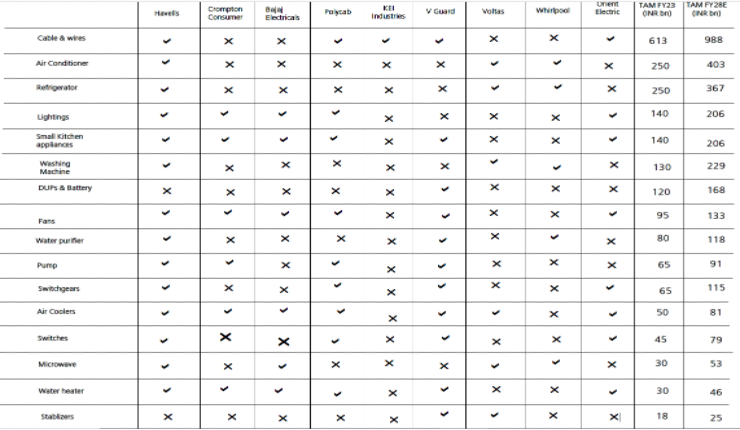
With the increased penetration of core categories among consumer durables, companies are now expanding their product portfolio to adjacencies and newer categories which would help to widen TAM.
This diversification approach allows brands to leverage their existing strengths, reputation, and customer trust to penetrate new markets and cater to a broader range of consumer needs. For instance, Orient Electric has successfully forayed into categories like small home appliances, switches, switchgear, and house wires, complementing its core portfolio of fans and lighting products.
Exhibit 15: Consumer durables industry market size and competitive estimates
Source: Company, Ambit asset management
While diversification may seem an enticing strategy for expanding market reach and embracing new horizons, prudent consideration of its drawbacks is imperative. A foremost concern arises from the potential dilution of a company's focus from its core competencies. This shift in focus may inadvertently lead to an erosion of the brand's competitive edge in its original stronghold, resulting in a loss of market share to more focused competitors.
Another potential concern is diversification through acquisitions where successful realization of synergies hinges on navigating intricate integration challenges. For instance, the Havells acquisition of Lloyds underscored the intricate nature of post-acquisition integration, with operational disparities and capital allocation complexities emerging as formidable hurdles.
Another example is Crompton’s acquisition of Butterfly, with the two being completely different business models, integration of management ideologies and strategies remains a key concern. The judicious management of these multifaceted considerations is imperative to ensure optimal outcomes within diversified investment portfolios.
Nonetheless, diversification offers reduced business risk through market expansion, leveraging synergies, and enhanced brand equity. In the pursuit of diversification, companies should prioritize prudent capital allocation and strive for non-dilutive returns on capital employed (RoCE). By rigorously assessing the prospective returns of diversification ventures and optimizing resource allocation, companies can enhance their long-term financial sustainability and value creation. This strategic approach ensures that expansion efforts not only broaden market presence but also contribute positively to overall shareholder returns, underscoring the importance of aligning diversification initiatives with robust capital efficiency metrics.
6. Commoditization:
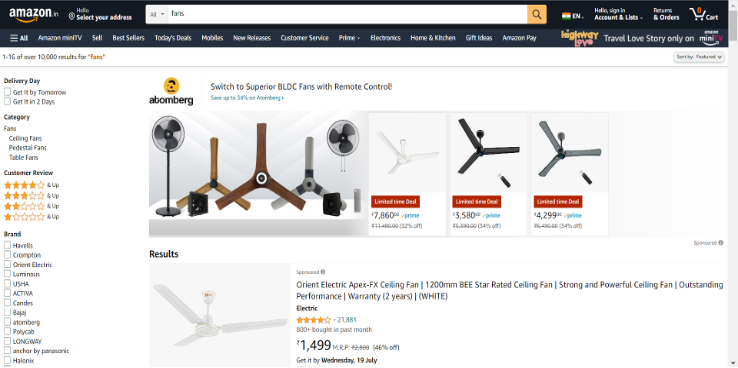
As technological advancements and global supply chains become more accessible, product differentiations have diminished, leading to a narrowing gap between offerings from different manufacturers. Consequently, consumers often perceive little distinction between competing brands, reducing the significance of traditional push-driven marketing strategies.
Exhibit 16: Merely searching for Fans on Amazon gives more than 10000 results
Source: Amazon India website, Ambit asset management
In this context, companies in the consumer durables industry face a pivotal shift towards emphasizing branding and advertising for customer pull. Establishing a compelling brand identity that resonates with the target audience becomes crucial in capturing market share and fostering customer loyalty. Successful branding not only differentiates products in a crowded marketplace but also fosters emotional connections with consumers, engendering brand loyalty that transcends mere product features. Orient historically has a higher sales promotion expense as compared to other brands (Exhibit 16) and has a good brand pull for its products. The partnership with MS Dhoni since 2007 has indeed worked quite well for them and the Orient brand page has the highest number of followers on Social media handles such as Facebook and Instagram.
Apart from that focusing on the specific needs and wants of the consumer is also important for favourable customer reviews and increasing acceptability and demand for the products.
Exhibit 17: Sales promotion expenditure as % of sales for major companies

Source: Ambit Capital research
7. Change in distribution model:
Orient Initially adopted the master distribution model for its products, identifying one key master distributor for each region who would be the sole point of contact for the company. This helped the company manage its inventories and products quite efficiently. However, this led to limited visibility of the specific product needs of end customers as distributors were solely connected to the end users.
To improve its distribution reach and accessibility in the markets where master distributers were weak Orient adopted the Go to Market strategy. Starting with the eastern region, it adopted the direct dealer redistribution strategy going very intensely into the distribution channel and consequently adopted it in the southern region in the states of Karnataka, AP and Telangana.
Management in Q4 Concall on change in distribution model - Distribution has been our strength and through all the initiatives in the DTM market we are replicating the learning in the MD market, we see distribution further increasing big time, in e-Commerce, Modern Trade, LFR; LFR are the Large Format Retail stores, I think we have an excellent product range, ready for these channels. And there is excellent traction already coming in the last couple of months. And there are separate teams altogether, developed the whole digital team and the Modern Trade team and a lot of recruitment was done in the last two quarters. Separate teams are handling these channels. So, I see all the channels growing pretty well with the kind of range we have.
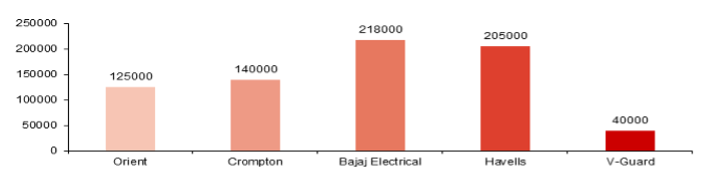
Companies are also increasingly focusing on Direct to customer (DTC) model by opening EBOs and increasing the retail footprint to directly connect with customers and faster reach of products to end customers. Potential examples include Orient’s Concept of Orient on wheels, Havells Galaxy stores & Stove Kraft opening 100+ EBOs of its Pigeon brand.
Exhibit 18: Distribution network reach among major players
Source: Ambit Capital research
We believe this twin distribution model can help Orient in better penetration in remote areas as well as increase the brand visibility consequently higher sales and distribution outreach.
Conclusion - In navigating the intricate landscape of technological disruptions and evolving consumer preferences, Orient Electric stands poised to navigate these challenges with strategic precision. By leveraging its legacy of innovation and quality management, the company can seamlessly traverse the disruptive currents. Adhering to a customer-centric approach, Orient's commitment to R&D and technological advancements can equip it to deftly integrate emerging trends into its product portfolio. The company's diversified offerings, spanning fans, lighting, and home appliances, provide a robust foundation to weather disruptions and swiftly adapt to changing market dynamics. With a resolute focus on enhancing brand visibility and consumer awareness, Orient Electric can solidify its position as a pioneer, propelling its growth trajectory amidst the currents of innovation and change.